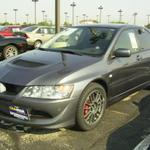
During a discussion on EvoM about organizing the community's work on modifying the Mitsubishi Lancer Evolution ECU, I threw out the suggestion of a wiki. Since no good deed goes unpunished, I ended up setting up a quick MediaWiki instance, and various folks have been working like crazy to move some of the best information in the EcuFlash forum on EvoM to the new wiki. The URL, at least for now, is evoecu.logic.net, but if this looks like it'll take off, there's no reason it should be tied to my domain, so I'll probably register something specific for it.
It's nice being able to give something back to a community like this; I haven't been doing much disassembly lately, but hosting, I can do. :-)
So, after a bit of logging, I've finally narrowed down the fueling problem I've been having: my fuel pump. The stock Evo VIII fuel pump comes equipped with a pressure relief valve, which starts dumping fuel right around 65psi; with a stock base fuel pressure of about 43psi, that means you start dumping fuel at right around 22psi, and anything above that is pretty much a lean condition waiting to happen. So, your injector duty cycles spike suddenly, and you start knocking. The fix? A replacement 255lph high-pressure Walbro fuel pump, which turns out to be one of the simplest drop-in replacement items I've ever had the pleasure of installing (at least, as long as you install it when your tank is just about empty). Because of the unique design of the Evo's fuel pump relay circuit, you don't need to upgrade your fuel pressure regulator as part of this exercise, a welcome change from the DSM world. Injector duty cycles now get up as high as 93%, but that's much better than being completely out of fuel. I'll need new injectors before I can turn the boost up much more than a few psi more, though.
Another change I've made is the addition of a JDM MAP sensor (an original Mitsubishi part from the Japanese version of the Evo IX). This rather unremarkable direct replacement for the USDM MAP sensor gives you one very useful thing: the ability to both log boost (up to about 32 psi), and to alter the ECU to target a desired boost level, rather than a desired load. That makes for much more predictable tuning; rather than having boost spike during hot weather (which is exactly the opposite of what you want), it gives a repeatable boost target based on absolute pressure. One oddity to the ECU changes is that, because it's based on absolute pressure (rather than gauge pressure), you have to tell the ECU what your altitude is to get your calculations to work correctly. Where this becomes problematic is when you make a drastic elevation change (say, by going to a track in another state), but don't change the offset: your boost is suddenly lower or higher than before. Right now, I'm running about 21psi (only slightly higher than stock), and I'll probably bump that up a few psi before I'm done mucking with it.
Yet another change was finally getting the AMS downpipe that I picked up a few months ago onto the car. I bought a couple of 3" flanges and gaskets from Performance Autowerks, and using a bit of spare 3" stainless tuning I had lying around, welded up a rather ugly test pipe to connect the downpipe to the AMS catback that came with the car. It worked out pretty well; the car is obviously louder, but I don't appear to have any leaks, and the car pulls noticably harder early in the RPM band. The one downside: I had to remove both lower braces that would normally run underneath the downpipe, because the whole assembly hangs too low for them (for the front bar, there's just no hope of reattaching it; for the rear bar, it fits, but rattles rather distinctively when the car warms up). Small price to pay, and I can probably weld up a replacement frame that's stiffer later anyway.
Coming in a few days is the last piece of the puzzle for a while: an Innovate LC-1 wideband oxygen sensor. This gives me the last piece of information I'm needing to fine-tune the car: my real air/fuel ratio. Hopefully this will give me what I need to bring the injector duty cycles down a bit at the top end (since I'm quite certain the car is running rich now, but leaning it out without some way to measure it is asking for trouble). Once I have A/F dialed in safely, I can play with timing and boost to make more power.
The stock Evo boost control system is actually pretty good; wastegate duty cycles are controlled based on load, which gives a decent approximation to boost if you're smart about it.
The problem is, it can't actually hold boost beyond about 21-22 psi without modification. One popular approach is to remove/resize the restriction "pills" in the stock vaccuum tubing to the wastegate/compressor housing, but that only goes so far.
So, the next big thing (for those unwilling to switch over to a manual boost controller) is a 3-port GM boost control solenoid (AC Delco part number 214-474, or GM part #1997152; the wiring pigtail is AC Delco part number PT-374). You completely replace the stock BCS with the GM unit, which gives you more than enough fine-grained control and higher boost levels than most folks will ever need.
So, of course, I installed one today. ;) The installation went pretty smoothly; you just solder a 10-ohm/1W resistor into one of the pigtail wires, snip the stock BCS plug and solder the pigtail in it's place, find a convenient place to mount it, and the replace all the vaccuum lines from the compressor housing, wastegate, and post-MAF intake pipe to the new solenoid. After that, you start dialing in your wastegate duty cycle, boost error correction, and boost desired load tables. Here's a tip: don't accidently reverse the intake and wastegate lines; you'll find yourself dramatically overshooting whatever boost levels you think you've tried to dial in. ;)
So far, I'm happy, but I'm still running lower boost than I would under normal conditions. Over the next few days, I'll get back up to 22-23 psi, and see if I can get it to hold without tapering off. One interesting thing is that, because you can taper off the boost slowly with RPM if needed, you can pretty much completely eliminate boost spiking. Nifty stuff.
Next up in the area of boost control: adding a JDM MAP sensor, and changing the car over to targetting boost instead of load, which will inevitably make more sense when tuning.
To save someone else the trouble of finding this out the hard way: it seems that FIC manufactures two injector types, one for DSMs, and one for Evos. The difference is subtle: on the Evo injector, the outlet of the injector is a straight tube, which the large lower seals slide onto. On the DSM injectors, there's a flat surface on which the seal rests, and the outlet then dives inward, then expands outward, like a bell outlet. The outermost edge of that outlet is just small enough to fit into the broad opening in a DSM head, but is too large to fit in the slightly smaller Evo opening.
So, I now have a very nice set of DSM 950cc injectors that I'm not sure what to do with. I may hang onto them for initial startup testing with the 2g, since they'll be much easier to dial in initially than the 1600s I already have and plan on running regularly. It was half-tempting to throw the 1600s in the Evo, but they'd be far too much of a hassle to get working properly on something I drive to work every day.
I pulled the shifter base bushings out of the Eclipse and popped them into the Evo today. For anyone thinking this is going to make a huge difference, I submit to you that the entire shifter base is made out of plastic. I wasn't expecting a significant change of behavior, and I got exactly what I expected: a mild improvement in transmission activity transferring to my hand, but that's about it. The Laser and Eclipse both improved dramatically after changing those out, which probably says more about the state of the original bushings in those two cars than the stiffening qualities of the metal bushings.
So, if you're thinking of adding these, do yourself a favor: get a cheap set off of eBay; they're not worth much more than the cost of the metal and the time turning them in a lathe, but they're probably the only thing you can do to stiffen up the shifter.
Man, I'm spoiled by the WRX shifter, after we installed a set of poly bushings on that one...
So, we went to the rain date for the Shootout over the weekend. Despite cold temperatures all weekend, there was still an incredible turnout, which makes one wonder how big the event would have been if it could have been held on the original date.
As usual, I flogged whatever car I happened to drive out there at the track. I made the mistake of entering "Evo Stock Appearing", which turned out to be a pretty big mistake; I was the slowest car there, because I wasn't just stock-appearing, I was stock (sans catback, intake, and flash). As seems to be my style, my best run of the day was my first: 13.353 at 102.77mph, with a lousy 1.843 60' (I later discovered that I was running 40 psi up front and 35 psi in the rear, not exactly condusive to a good launch; at 25psi and a couple of tries, I was at 1.832, so I definitely need to work on getting this car off the line). I've transcribed the full timeslips, if anyone is curious.
Things learned? First, the tires on the Evo suck, but can be made slightly less sucky at lower pressure. Second, the constant 85% injector duty cycle I was seeing is about as high as I want to go; I have a set of 950cc/min injectors ready to go in (as soon as I find a few minutes to dial them in), and I'll get a pump ordered shortly. Third, I really want to run E-85. :D Race gas for the price of regular 93 octane? Yes, please.
Overall, it was a pretty good weekend; we froze our butts off Saturday night after the racing with Shep, Shearer, Yusuf, Mike, Adam, Vernon, Keith, and a bunch of other folks randomly popping in and out, and just generally relaxed (as much as we could in 35F weather, anyway). Good times.
This post is more for my own benefit than anyone else's; every time I fire up IDA Pro with a fresh ROM, I have to re-learn how exactly to get to a usable disassembled image.
Assuming you have an ECU image from your car saved as a .hex with EcuFlash, fire up IDA Pro (I'm currently using 5.0.0.879, so this might differ from version to version), and go to "File" and "Open...". Select the "Hitachi SH4B" processor from the drop-down, and just keep clicking OK until you're presented with the ROM view.
The first four bytes of the ROM tell the processor where to jump to when booting; so, type "g", and enter the address stored in those first four bytes and hit OK. Then, type "c", and watch as IDA Pro disassembles your code automatically in front of you.
After that, though, you're on your own. See AktiveMatrix for the latest in what people are doing with a disassembled Evo ECU, as well as the forums at OSEcu Roms and OpenECU.
We've been working on Erica's car lately (the WRX), and one thing I've noticed about that car: the shift linkage feels like a race car's, after installing the short shifter and polyurethane shifter bushings. The Evo shifter, on the other hand, feels a bit vague, especially when you compare it to the unbelievably crisp steering and suspension. So, when I came across a good deal on EvolutionM for a set of new Buschur Racing 6-speed shift cable end bushings, I snapped them up.
My set didn't come with instructions, but it's really no different than any other car. Locate the shift linkage (in the case of the Evo 6-speed, the cable ends are actually mounted at the rear of the transmission, next to the firewall in an east-west arrangement, as opposed to the DSM transmission, where they're mounted up front and north-south), remove the retaining clips and cotter pins, muscle out the old bushings (in my case, the small one actually stuck to the shaft off the transmission, while the large one required a fair bit of convincing to eject itself from the cable end), grease up the new bushings (both the shaft and the outside, so it can slide freely around in the cable end), slide them into place, muscle on the new retaining circlips and cotter pin, and you're done. Take the strut tower bar off to give your hands a bit more working room, and remove the battery too if you find that to keep getting in your way (I did it without removing the battery, but wish I had).
Result? A slightly more crisp feel to the shifter, but it's still vague. Next up will be replacing the bushings where the shifter itself mounts to the floorpan (the bushings are even identical to the ones in the Eclipse and Laser), which I suspect will do exactly what it did on the DSMs: get rid of that slightly "mushy" feel, and let me feel what's actually going on in the transmission rather than hiding errors I might make behind a bunch of rubber.
While messing around with all of this, I made another discovery: the prior owner replaced the lower intercooler pipe with an aftermarket one. It definitely looks like an AMS pipe, but I'll need to look a bit closer to tell for sure.
Coming soon: I picked up an AMS 3" downpipe off of EvolutionM the other day (to go with the catback that came on the car), so now I need to either fork over $100 to AMS for a test pipe, or find someone who can sell me a couple of 3-bolt flanges that match up with the AMS flanges, and make my own. (I'm leaning toward the latter, especially, since I can probably work a nice resonator into the mix while I'm doing it).
So, after realizing that the intake that Buschur Racing sells is really nothing much more than the DSM eBay intake, I picked up one of those for $25 and got rid of the stock airbox. No noticable performance impact (as expected; even with a bit of tuning, an open-element air filter doesn't improve much on the stock Evo airbox), but I got out of it what I was after: I can now actually hear what's going on with the BOV (oh, sorry, "DV"; EvoM folks love to spend all day arguing over semantics, such as "blow-off valve" vs. "diverter valve"), and it became obvious that my part-throttle hesitation was happening just as the valve was fluttering. This was also the first time I noticed that I appear to have a metal Evo 9 MR valve; it's generally considered to be a decent upgrade over the stock plastic piece.
So, upgrades so far (that I know about) appear to be an AMS catback exhaust (with adapter to the stock cat), the metal MR BOV, the intake I just added, a reflash from some unknown vendor, and possibly an upgraded clutch (I still haven't had a chance to peek under there through the clutch fork boot to see if I can tell what it is).
I've started off with a disassembly of the flash that was on the car when I bought it, in an attempt to find where the various maps are hiding so I can actually dial the car in a bit better, but the reflashed image is definitely a significant improvement over stock; I tried a stock image with a few adjustments, where boost was quite a bit lower, and the car seemed to run significantly richer right across the board. So, until I can extract the fuel, timing, and boost maps from this aftermarket image, I'll leave it running that for now; it's significantly faster with the unknown maps. (One interesting change: the stationary rev limit was set to 6000 RPM, and a ton of timing appears to get pulled, resulting in very quick, very violent, building of boost at the line. Nice.)
Unfortunately, I'm basically starting from scratch with this image, like I did when I started tuning the 1g; I'm going to have to just block out large chunks of time to read the code and disassemblies other folks have done. (I don't even know what the registers are right now. ;-)
Overall, though, I'm extremely happy with the car so far. Planned changes to what I have right now include a downpipe/testpipe to finish off the exhaust, and probably a bit of playing with the stock boost control system to squeeze a few more PSI out of it (specifically, pulling a restrictor and resizing another one), although I'll need to get farther along with reading through this ROM before I'll be able to make significant boost changes without a manual boost controller. At that point, I think I'll be basically happy with the car; it's fast enough as-is.
Over the weekend, after a lot of searching, we finally found a replacement
for the Jeep and Laser that I've been using as (unreliable) daily drivers:
a 2005 Graphite Gray Mitsubishi Lancer Evolution MR. Just over 31k miles
on the odometer, and the only mods I can see are an

AMS catback and a set of
engine hood struts (there's also a bit of confusion about the clutch;
while it's certainly not stiff by any stretch, it definitely feels heavier
than a stock Evo clutch). It also has brand new "Nexen N3000" tires; no,
I'd never heard of them either, but the tread pattern is fairly similar
to some of Toyo's tires, and they're "ultra high performance summer tires",
meaning they're going to be a handful this winter (but a lot of fun until
then).
First impressions: this car is unbelievably fun. It's obviously almost as fast as the Laser (if not faster), but it doesn't feel like it's straining to do it. Turn-in is crisp, and there isn't a hint of chassis flex (in comparison to the other cars in the household). Braking is just amazing. This car is pure driver confidence, something you just wouldn't expect from a four-door grocery-getter. The six-speed really didn't take much to get used to, although the gears are noticably shorter; you're spending a lot more time shifting. The active center diff seems to be a fun toy; I'll see if it makes much of a difference this winter. :-) One huge item for me is available head and leg room; I actually fit perfectly in this car, with a ton of headroom for a helmet, and plenty of room (almost too much) for my legs, and the steering wheel drops right into reach.
To say I'm happy with it is an understatement. Now that I no longer have to spend my free time working on the other "daily drivers" when they break, maybe I'll actually make some progress on the Eclipse, and I'll even have something DSM-derived to take to the Shootout this year. Good stuff. :-)